The new discovery of the body at the Renaissance provoked a reaction among many conservative Christians. Catholics complained that it went against tradition. Protestants expressed their disgust at the proliferation of 'indecent pagan art'.
Pope Julius II (1503-1513), who had commissioned Michelangelo to paint the Sistine Chapel saw to it that the private parts of naked figures were hidden under (painted) pieces of cloth.
A century later, Pope Innocent X (1644-1655) started the socalled fig-leaf campaign. The exposed phalluses off Roman statues were chiselled off and covered with a fig leaf. This approach continued until far into the 19th century.
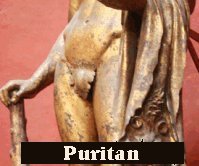
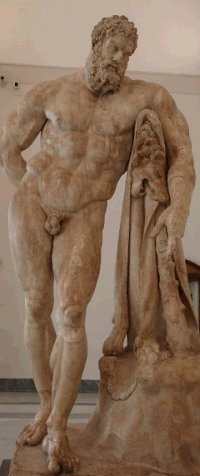
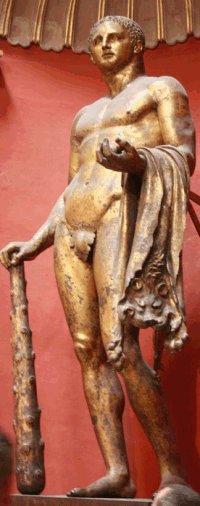
The image on the left shows a classic Hercules, found in Pompei and now in the Palazzo Farnese. On the right we see a Roman bronze statue of Hercules, now in the Vatican Museum, which was fitted with an appropriate fig leaf . . . .
John Wijngaards |